Oil prices have fallen back, the risk of military escalation has receded, and we have moved our outlook from cautious back to neutral.
Download PDF VersionPredictions of doom as a result of the Iran war were, once again, overdone. Even relatively moderate forecasts about the medium-term effects of the closure of the Hormuz Strait and the damage to energy production facilities were quickly rendered obsolete by the fall in the oil price. With the tail risk of a military escalation basically off the table, we are moving our outlook back from cautious to neutral. This means we expect the markets to be driven by macroeconomic and business fundamentals from here on.
As we have pointed out in all of our recent quarterly reports, it is easy to forget how positive the macroeconomic fundamentals are. The world economy is growing in sync, with no major region in recession, which in itself is relatively unusual. The pace of growth may not be that fast, but moderate growth is positive for corporate profits and helps to keep inflation contained.
In equity markets, the AI theme has become even more dominant, with individual stocks, industries and countries in many cases being divided into winners and losers based on their position in the AI infrastructure “stack”. Even if AI is not the only game in town – US small caps and value stocks have outperformed this year, for example – the importance of AI investment for growth in many economies, including the US, means that the macroeconomic outlook is now tied up with the fortunes of this technology, which creates a double dependency on this theme. Nonetheless, while a downturn or disappointment in the AI narrative would clearly be bad news for equity markets, it might not necessarily lead to a stock-market bust.
There are, therefore, still reasons for caution in the quarter ahead. A further risk, on top of concentration in AI stocks, is inflation and the risk of interest rate hikes, especially in the US. US core inflation has been sticky at an above-target level in recent quarters. It remains to be seen how severe and long-lasting any impact from higher oil prices proves to be. The new Fed chairman, Kevin Warsh, has warned that he is determined to deliver on the Fed’s inflation objective. While a rate hike or two might not be a disaster for the equity markets, they could clearly create a less favourable backdrop. A further risk is the ever-present geopolitical tensions erupting in several hotspots at any time.
Inflation developments in the US and other countries will be critical in setting the direction of monetary policy. The direction the US Fed takes will be key and a rate hike has the potential to cause market volatility. The strength of the US economy will also be an important input into the Fed’s thinking, with some recent data suggesting the labour market has rebounded this year.
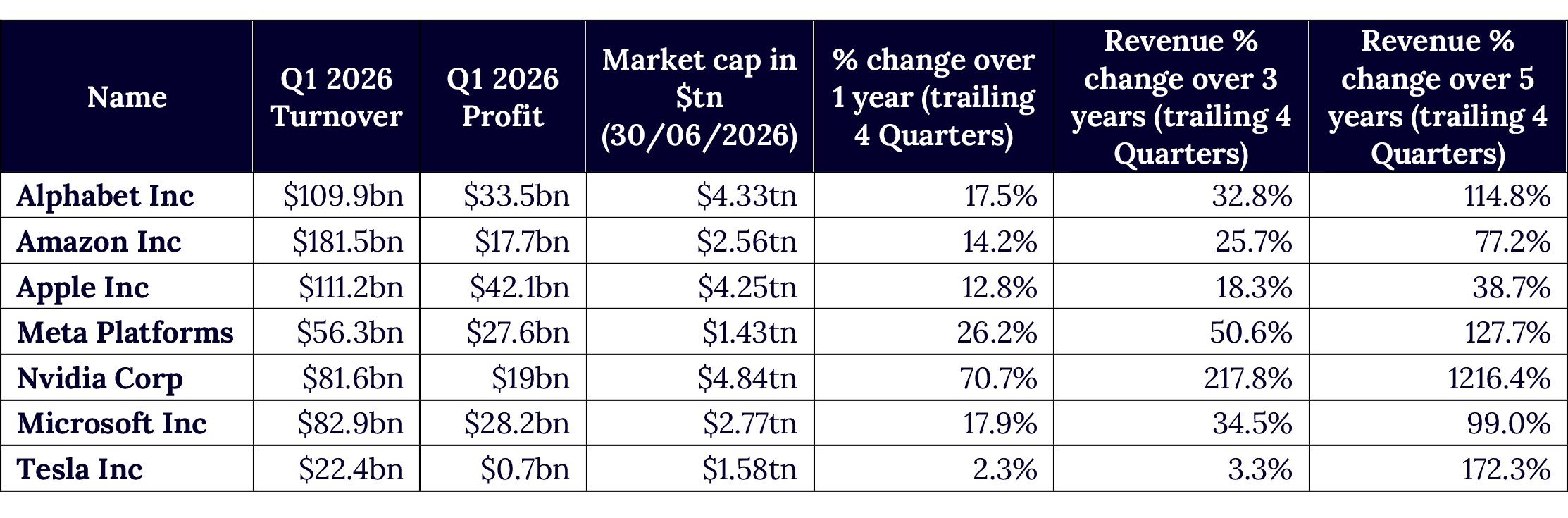
A new dimension will be added to the AI theme over the next six to nine months with the expected Initial Public Offerings (IPOs) of Anthropic and OpenAI. These will give the market access to pure play AI “labs” (model builders) for the first time. The IPOs will no doubt attract very high demand. This influx of capital has the potential to increase market concentration in the AI theme, which could distort markets. More incoming information on the revenues the hyperscalers, such as Microsoft, Meta, Amazon and Alphabet, are earning on their AI investments will also affect the narrative about the AI boom.
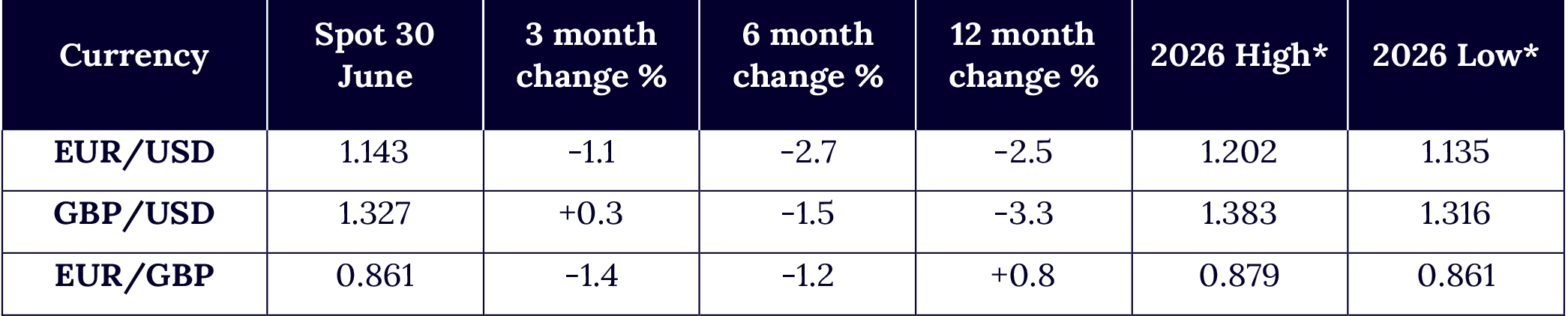
After a dip in the first quarter, technology stocks stormed back between April and June. The Nasdaq rose by over 20%. However, the index peaked in early June and was volatile in the final month of the quarter, as jitters about AI grew. Leadership has moved away from the Magnificent 7 (“Mag 7”), all of which, except Alphabet, underperformed over the quarter again, leading them to be rechristened the “Lag 7” by some analysts. The market has become concerned about the huge capital spending by the hyperscalers Meta, Microsoft, Alphabet and Amazon, which is eating up most of their free cash flow, and the lack of visibility on the returns on this investment. Heavy corporate users of AI are reported to be restricting use of the technology by staff in response to rising bills, casting doubt on some of the more optimistic revenue forecasts. Moreover, opposition to the construction of new data centres has become increasingly vocal and could upset the hyperscalers’ investment plans. The rising cost of memory chips is also squeezing margins. Microsoft and Meta have been the hardest hit and are down around 25% over the past year.
The immediate beneficiaries of the AI build-out have been chip manufacturers and their share prices have gone stratospheric this year. The Philadelphia Semiconductor Index in the US doubled in the first half of the year, with some individual stocks rising up to 3 to 8 times. It has been a similar picture for chip and chip-related stocks in other markets, for example ASML (Netherlands), SK Hynix and Samsung (South Korea), TSMC (Taiwan) and various niche semiconductor stocks in Japan. However, there was a pullback in the sector from late June, with many chip stocks giving up 20-25% from their highs. The semiconductor sector has historically been prone to boom and bust cycles, so are we just witnessing another one of these, or are we in a “supercycle”? A supercycle is best defined as a permanent upward shift in demand. The case for a structural shift is that chip demand has now become divorced from PC and smartphone sales. Computing capacity has become a basic infrastructure that will be needed long into the future. Supply is constrained and will remain so, given the length of time needed to build new semiconductor fabrication plants. in the short term at least, the data centre builders (i.e. the hyperscalers and others) are far more worried about falling behind in building enough computing capacity than about overspending. Their huge investments will therefore likely continue for the foreseeable future. As a result, some analysts believe the cycle has not peaked yet.
Is AI a bubble? Some (hopefully) common sense reflections
We touched on this question six months ago in the January market report, concluding that we do not face a re-run of the dotcom crash. Here, we offer a few further thoughts.
As a new technology, AI will clearly disrupt some businesses and markets, and some companies will emerge as winners, while others will be losers. The winners will see huge share price appreciation, even from current levels, while the reverse will be true for the losers. The market is currently trying to work out which of the many potential candidates will be the ultimate winners – but in spite of all the analyses and forecasts at present, ultimately no one really knows. Since markets always overshoot, this process will inevitably push the share prices of certain stocks up too high, and they will crash back to earth later. We can also be fairly certain that there is hype in some parts of the AI narrative – we just do not know exactly where. A pragmatic approach to these unknowable’s is not to come down on one side or another, but to take a “both and” approach. All of these can be true at the same time: AI is a transformational technology and there is hype in some parts of the narrative and there will be a bear market in equities at some point. This points (a recurrent theme of our market reports) to maintaining a diversified portfolio that is exposed to the opportunities, but also hedges some of the risks. A diversified portfolio is, by definition, one that takes a balanced view and does not concentrate on just one theme.
An important difference between the AI boom and previous bubbles, such as the dot-com and the subprime mortgage bubbles, is that the AI boom is not founded on borrowing and leverage (like the house price bubble) or on unproven businesses (like the dot-com bubble). Most AI investment is being carried out by the magnificent 7 tech companies, which also all happen to be among the 10 largest companies in the world. They are hugely profitable and are financing this investment almost purely from their own free cash flow. In a sense, the hyperscalers could stop investing tomorrow and their businesses would be largely unaffected. There would be a bust for some of their suppliers further down the value chain, but the tech giants themselves would sail on regardless.
Would an AI downturn drag the rest of the stock market down with it? There is a strong chance it would, but it is not certain. An optimistic reading of market movements over the past month is that some of the steam has already come out of the AI story and the slack has been taken up by other areas of the market, without equity markets falling in aggregate. The absence of leverage in funding the AI investment boom is important here. At the level of the public markets, there is no chance of a vicious and self-feeding cycle of market declines leading to rapid deleveraging, as occurred during the financial crisis. If publicly listed semiconductor stocks, or even tech stocks in general, were to halve, this would not jeopardise the survival of these businesses. Some corners of the market, such as private markets, where there is a higher degree of leverage, could experience turmoil, which could blow back on the banking system, but would be unlikely to pose an existential risk.
Signs of a reacceleration of growth
US Gross Domestic Product (GDP) growth was a solid 2.1% in the first quarter, following a soft fourth quarter of 2025 due to the government shutdown in October and November. Growth is expected to remain at a similar pace in the third quarter, which is in the “Goldilocks” range that is typically positive for the financial markets.
Job growth has been one of the areas pointing to a strengthening economy, recovering from around zero in 2025 to around 50,000 jobs per month this year. As had been expected, owing to the tax rebates delivered by the One Big Beautiful Bill, retail sales have also strengthened and were up 6.9% year-on-year in May. Consumer confidence remains relatively weak, but at least we are in no danger of over-exuberant consumer confidence and a subsequent bust. The manufacturing sector has also strengthened, with the ISM purchasing managers’ index well above the no change level of 50 at 53.7 in June. The prices component leapt in recent months as input prices surged, but fell back again substantially in June, an encouraging sign that inflationary pressures will begin to ease.
The rise in oil prices has led to a jump in headline inflation, with Consumer Price Index (CPI) inflation touching 4.2% in May. Core CPI inflation has picked up too, albeit by less, rising from 2.5% in January to 2.9% in May, while core Personal Consumption Expenditures (PCE) inflation, the Fed’s preferred measure, edged up from 3.0% in February to 3.4% in May.
The question is whether this uptick in core inflation will be sustained or will reverse again. The new Fed chairman, Kevin Warsh, has made hawkish commentary, which has led some analysts anticipate rate hikes later in the year (see Interest rate outlook).
US-Iran MoU good news for the flat eurozone economy
As a large energy importer, Europe will benefit from hostilities ending in the Middle East. There was already a positive impact on inflation in June. Headline inflation fell back from 3.2% to 2.8%, while core inflation stood at 2.4%. This has taken some of the pressure off the ECB to follow up its 25bp rate hike in June with a further increase.
GDP contracted by 0.2% quarter-on-quarter in the first quarter of 2026, but this was distorted by a temporary factor in Ireland (relating to front-loading by US multinationals ahead of the introduction of US tariffs, and its unwinding). The overall picture in Europe is of an economy that is somewhere between flat and growing slowly. The S&P manufacturing Purchasing Managers' Index (PMI) for the euro area has been above 50 since February and was 51.4 in June, pointing to modest growth in manufacturing. Retail sales were up 1.0% year-on-year in April, while the unemployment rate was 6.2% in May, more or less unchanged from a year ago.
A sluggish economy will benefit from energy price easing
UK GDP rose 0.6% quarter-on-quarter in the first quarter of 2026, a relatively robust performance, but this followed a weak fourth quarter of 2025. The year-on-year growth rate of 0.9% captures the subdued underlying rate of growth better. There has been some other encouraging data. The S&P manufacturing PMI has been above 50 since the end of last year, although it eased back from 53.9 in May to 52.5 in June, suggesting momentum may be slowing. Consumer spending remains sluggish: retail sales were up 1.4% year-on-year in May. The labour market is flat, with the unemployment rate edging up slightly from 4.6% to 4.9% over the past year. The fall in energy prices will boost real consumer incomes, which should provide some support to consumer confidence and spending in the second half of the year.
The rise in oil prices has so far had a smaller impact on UK inflation than feared: headline CPI inflation was unchanged at 2.8% in May, while core CPI edged up marginally from 2.5% to 2.6%. Both measures are below US levels. Moreover, services inflation, which some see as the most reliable guide to underlying inflation, has fallen below 4% for the first time since 2022. Therefore, there are some encouraging signs that the UK’s stubborn and persistent inflation problem is continuing to unwind gradually. The decline in wage growth to 3.4% in February to April, from over 5% a year ago, provides further evidence of this.
China continues to have a two-tier economy; improving data from Japan
The Chinese economy continues to be split between a very strong export sector, which is grabbing market share around the world and causing concerns for its trading partners. On the other hand, domestic demand remains weak, pulled down by the chronic malaise in the property market, which has dragged on for five years and shows little sign of a decisive turnaround. This split is evident in the macro data. Retail sales fell 0.6% year on year (yoy) in May, but industrial production, which is more closely linked to the export sector, rose 4.5% yoy. The strength of the export sector may be one of the reasons for the relative inaction of the authorities in boosting domestic demand. But since stronger domestic demand is one of the targets of China’s Five Year Plan, some analysts expect the authorities to announce further stimulus in the coming months.
Japanese GDP growth was stronger than expected in the first quarter of 2026 at 2.1% quarter-on-quarter. Prime Minister Takaichi’s fiscal stimulus should continue to support growth in the remainder of this year and into 2027. The influential quarterly Tankan business survey remained on an upward trend in the second quarter, rising from +17 to +22.
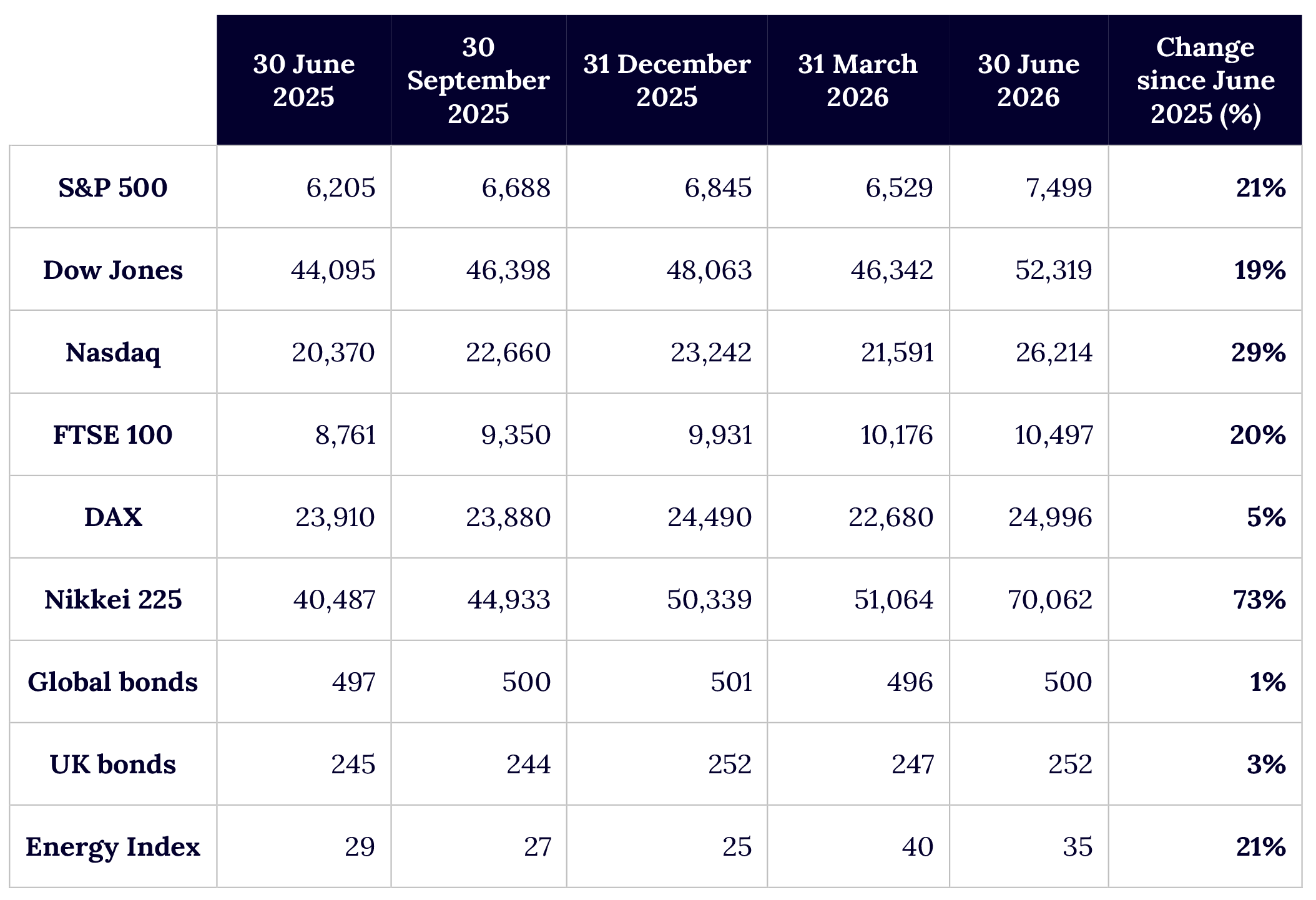
The new chairman of the Federal Reserve (Fed), Kevin Warsh, took up his post in May of this year, and held his first press conference at the June Federal Open Market Committee (FOMC). At first sight, he struck a hawkish note. He noted that inflation has now been above the Fed’s target for over five years – an implicit criticism of his predecessor – and said that the Fed will do what is necessary to return inflation to target. This could imply he is ready to raise interest rates. On the other hand, Warsh is also sympathetic to the argument that AI will deliver productivity gains that, in effect, increase supply and lower inflation. He also favours using different inflation measures that may produce lower inflation figures. So, as yet, the jury is out on what the direction of travel will be. Furthermore, we cannot forget that raising rates could bring him into conflict with President Trump. That might not prevent the Fed from hiking, but it could make things uncomfortable. Luckily for Mr Warsh, his position has been strengthened by the Supreme Court’s rejection of the president’s attempt to sack one of the Fed’s governors and he reiterated the centrality of the Fed’s independence at the recent annual central bankers’ get-together in Portugal.
Another change the new chairman wants to introduce is for the Fed to give less forward guidance to markets about its intentions and “reaction function”, i.e. how it might react to different events. Warsh’s argument is that it is better for the markets to make up their own minds about what will happen, rather than constantly being told by the Fed what to think. He announced a review of how the Fed communicates, which will be shared by the end of the year. Warsh also shortened the FOMC statement as a first sign of his intentions. One problem with a “say less” approach by the Fed is that it could increase the chances of the markets being surprised by a policy move. In the days before forward guidance, when central banks typically communicated far less with the markets, rate moves could often spark considerable market volatility. It is debatable whether Kevin Warsh is really prepared for that. For now, the Fed will continue to publish its rate forecasts, known as the “dot plots” (although the chairman did not contribute a forecast this quarter). These show that the committee is evenly split between forecasts of modest rate hikes and forecasts of modest rate cuts.
The European Central Bank (ECB) raised interest rates from 2% to 2.25% in June, in response to the pickup in euro area inflation in recent months. At the press conference in June, ECB President Lagarde noted that policy would be data-dependent going forward. The US/Iran MoU and the better-than-expected June inflation data have made further rate hikes by the ECB less likely.
The Bank of England (BoE) has been on hold this year while it assesses the impact of the energy price shock during the Iran war, particularly the second-round effects. However, so far, inflation data has been better than expected, which has reduced the pressure to hike rates. A majority on the Monetary Policy Committee believe that the slack in the economy will be sufficient to restrain second-round effects, but two hawkish Monetary Policy Committee (MPC) members, out of nine, voted for a hike at the June meeting. On balance, rates look likely to remain on hold for now.
The Bank of Japan (BoJ) raised interest rates to 1% in June, continuing its policy normalisation. However, if it expected this move to strengthen the yen it was disappointed, as the yen touched new lows of around 162 yen per dollar at the end of June. With interest rates well below the neutral level in the BoJ’s view, it will continue the normalisation process unless there is significant weakness in the economy and/or inflation, which is unlikely in the absence of an external shock. A further rate hike is therefore expected before the end of the year.
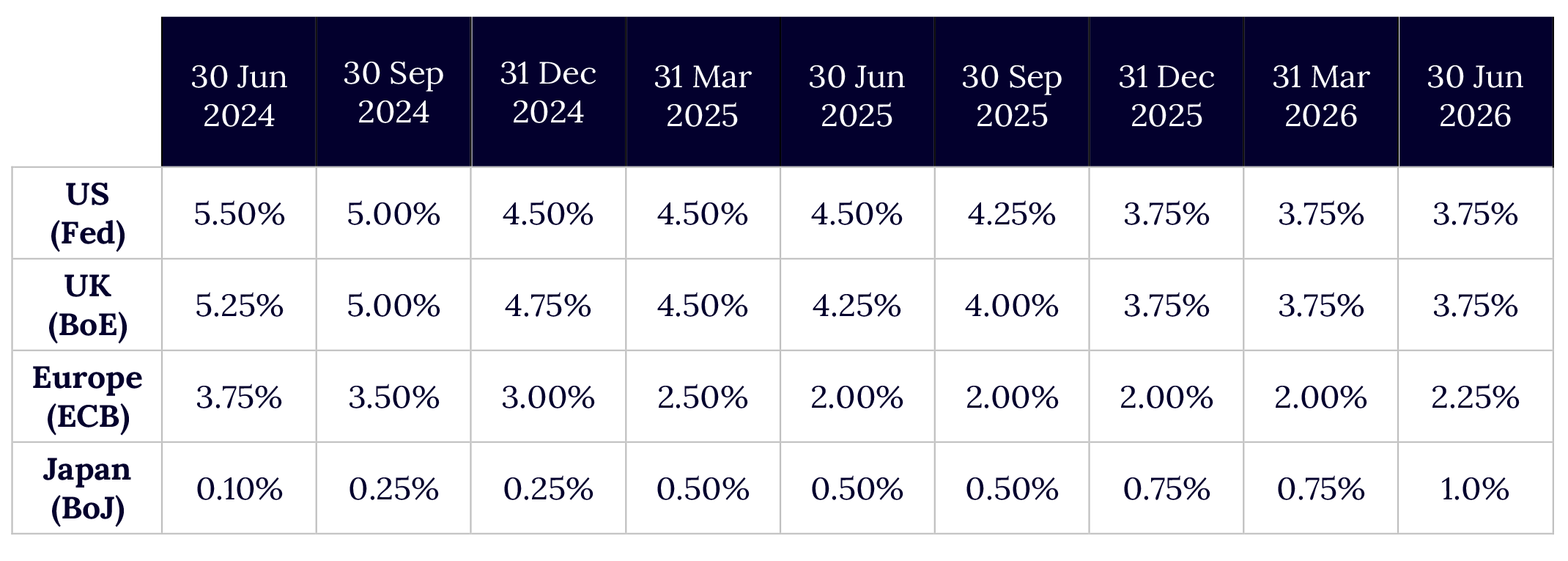
The following themes are intended as food for thought and do not represent a formal currency forecast.
Recent trend: down (stronger dollar)
Outlook: down
The dollar strengthened and the euro/dollar fell in the second quarter, breaking out of the narrow 1.15-1.18 range that had held for the previous year. After a pause in 2025, there has been a revival of the US exceptionalism story, as the growth gap between the US and Europe has widened again and the undisputed US leadership in AI has become more evident. Furthermore, the fall in energy prices since the end of the Iran war has reduced the chances of the ECB hiking rates again. The market has also been reassured by the new Federal Reserve chairman, Kevin Warsh, that the Fed will not bow to political pressure to cut rates.
Recent trend: neutral
Outlook: neutral
With no short-term interest rate gap with the US, sterling does not suffer the same drag as many other currencies, such as the euro. The Organisation for Economic Co-operation and Development (OECD) forecast that the UK economy would suffer the biggest hit among developed economies from the energy price shock, but by extension, the end of the war provides the greatest relief to the UK. The Bank of England is unlikely to cut interest rates in the short term, although if the Fed does hike, the BoE might not follow suit, which could lead to dollar strength.
Recent trend: down (stronger sterling)
Outlook: down
The euro/sterling currency pair edged down in the second quarter. The end of the Iran war led rate hike expectations in the euro area to be revised down sharply, which suggests the substantial rate advantage in favour of sterling will be maintained. The Bank of England is not expected to cut rates for the foreseeable future. Economic growth is tepid in both regions, but recent euro area data has been even weaker than in the UK.
With the Iran war ‘over’ and oil prices retreating back to pre-war levels, we are moving back from a cautious stance to a neutral one. This means we expect the markets to be driven primarily by macroeconomic fundamentals and industry/business performance going forward. We believe investors should continue to embrace the opportunities that equity markets offer, while maintaining substantial positions in less risky assets such as bonds and cash in recognition of the heightened background risks.
Within equities, the AI theme is clearly important and there will be some big winners in this space who will see large share price gains. But diversifying beyond this theme in terms of geographies, industries and small and medium caps, or maintaining broad global exposure (which automatically provides some diversification), is advisable. Care needs to be taken in ensuring that a portfolio really is diversified, as interdependencies have increased. AI dominates not just some equity markets but is also a key driver of the macroeconomy (e.g. in the US), creating a double dependency. Some emerging markets, previously thought of as diversifiers, are even more concentrated AI bets than the US – Taiwan and South Korea, for example.
After several years of rapid gains, gold’s bull run came to a halt in the second quarter, as geopolitical risks faded and expectations grew of possible US rate hikes. Gold has become more volatile over the past year or two but still has a role to play as a hedge in portfolios.
Turning to the less risky assets, bonds have recovered after a sell-off at the start of the Iran war. Clearly, bonds would be hit by an increase in US interest rates. But if inflation eases in the US and elsewhere faster than expected, bonds could see a rally for the first time in many years. There is therefore potential upside, but the timing is uncertain at present. Given the uncertainties, an allocation to cash also makes sense in the current environment.
The outlook has improved, but the case for becoming significantly more bullish remains unconvincing. The immediate geopolitical threat has receded, economic growth is holding up and the AI investment cycle continues to support markets. At the same time, inflation remains a concern, valuations are high in parts of the market, and geopolitical risks have not disappeared.
The more interesting development is the broadening of investment opportunities. Investors are shifting away from the handful of stocks that dominated markets in recent years, while improving prospects in other sectors and regions are offering more places to find returns. In this environment, success may depend less on taking more risk and more on being selective about where that risk is taken.
We therefore remain neutral on the outlook, favouring a well-diversified portfolio with a moderate and geographically diversified exposure to all mainstream asset classes and selective exposure to markets and sectors where valuations and fundamentals still offer room for further gains.
As always, the appropriate balance between risk and reward will depend on each investor's personal circumstances. We therefore encourage clients to maintain regular dialogue with us and their investment manager to ensure their portfolios remain aligned with their long-term objectives.
CEO