The year did not begin as expected. Conflict, rising energy prices and a shift in inflation dynamics have changed the backdrop for markets, and with it, the balance of risks.
Download PDF VersionFor several years, the global economy has defied repeated predictions of recession, despite higher interest rates and the introduction of tariffs. This resilience has supported equity markets over the past three years.
The recent surge in energy prices, driven by the Iran conflict, now presents a more meaningful test. While the impact may prove less severe than feared, current indications suggest it could prove more pronounced than previous shocks.
Unlike in 2022, there is less support from government spending and household balance sheets are not as strong. As a result, higher energy prices may weigh more heavily on growth, even if the inflationary impact is less extreme. A resolution to the conflict is also unlikely to deliver an immediate normalisation in prices or supply.
We identified rising US inflation as a key risk at the start of the year, and this is now beginning to materialise. Markets have responded accordingly, with pressure across equities, bonds and gold, while cash has held up relatively well.
A more favourable outcome would involve a quicker resolution, easing energy prices and a gradual return to rate cuts. However, this may take time. For now, central banks remain in a holding pattern.
Given continued volatility and uncertainty, including the risk of further escalation, we have moved our outlook from neutral to cautious.
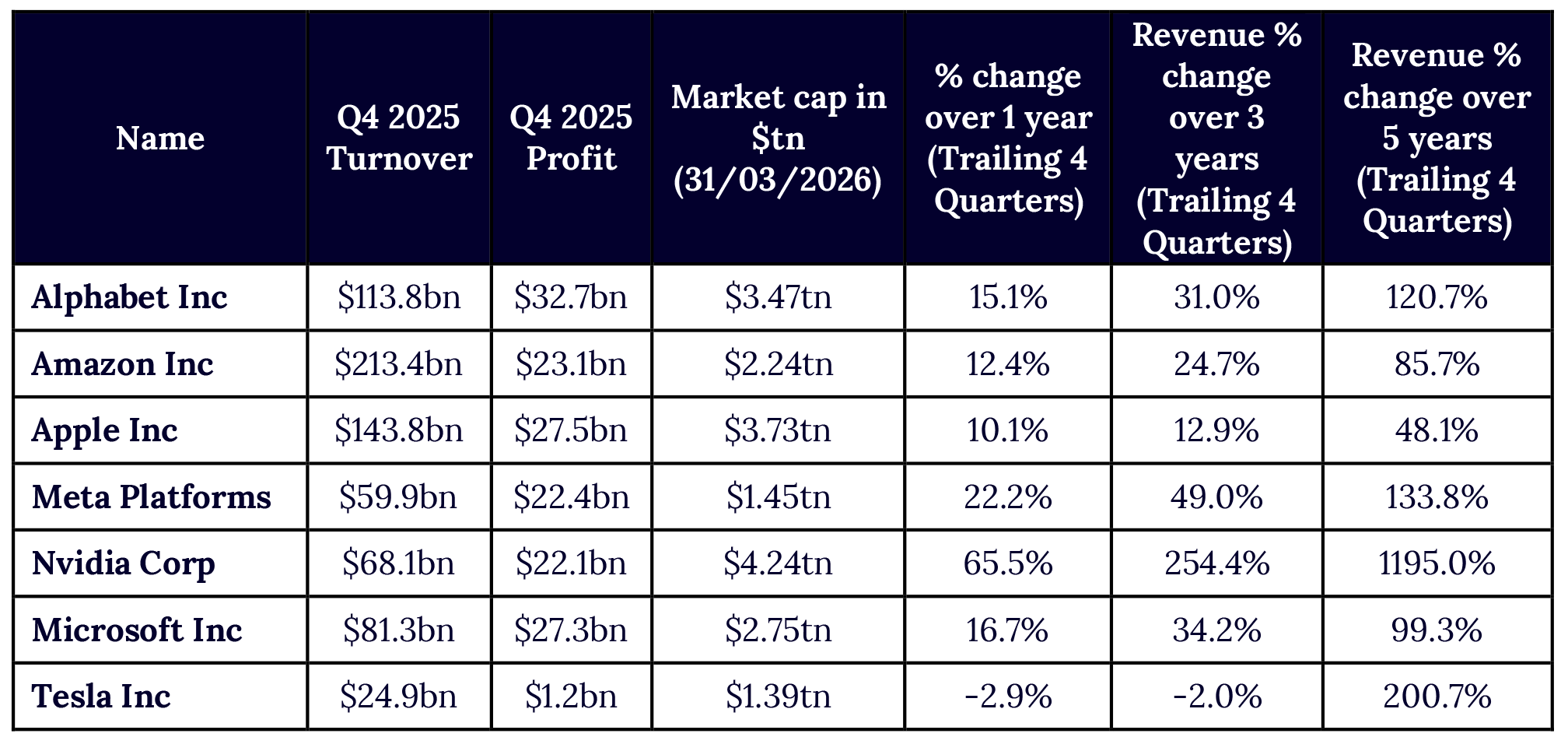
Technology stocks fell sharply in the first quarter, with the Nasdaq down 7% and most of the Magnificent 7 underperforming, led by a near 25% decline in Microsoft. Unlike last year’s recovery after a weak start, a similar rebound in 2026 appears less certain. The sharpest falls were in software and services, where AI is expected to disrupt existing business models.
As a growth sector, technology is sensitive to rising inflation and interest rate expectations. However, the recent weakness also reflects growing scepticism around the scale and returns of AI-related capital expenditure. These investments are absorbing significant free cash flow and challenge the sector’s traditionally asset-light model, with long-term profitability still uncertain.
US growth remains positive but has softened. Fourth-quarter GDP rose 0.7%, with the government shutdown weighing on activity, while full-year growth of 2.1% represented a moderation from recent years but remained supportive for markets.
The labour market has cooled, with job growth close to zero, although unemployment has only edged up slightly to 4.4%. Consumer spending continues at a modest pace, supported in part by expected tax rebates, while confidence has weakened but not to recessionary levels.
Manufacturing activity has shown tentative improvement, though rising input costs point to renewed inflationary pressure in supply chains. Inflation itself remains above target, with headline CPI at 2.4% and core measures higher. The recent rise in energy prices is likely to push inflation higher in the near term, with uncertainty around how persistent this proves to be.
Higher inflation may begin to weigh on real incomes and spending, increasing the risk of a broader slowdown. However, while the economy is more vulnerable than in 2022, it is too early to draw firm conclusions.
The euro area economy continues to grow slowly but steadily. GDP increased by 0.2% in the fourth quarter and 1.4% over 2025 as a whole, not far behind the US. Retail sales and employment remain stable, and manufacturing activity has edged into expansion territory, although rising input costs signal renewed inflationary pressure.
As a major energy importer, the eurozone is particularly exposed to higher energy prices. This increases the risk of a slowdown later in the year, with early signs already visible as inflation rose to 2.5% in March from 1.9% in February.
The UK economy continues to grow modestly and remains vulnerable to higher energy prices. GDP rose by 0.1% in the fourth quarter and 1.4% over 2025, broadly in line with the euro area.
Economic activity is subdued across the board. Unemployment has edged up to 5.2%, while retail sales remain weak and below pre-pandemic levels in real terms. Manufacturing has shown some improvement, although rising input costs point to early signs of energy-driven inflation pressures.
Prior to the recent increase in oil prices, inflation had been easing, with CPI at 3.0% and some moderation in services inflation and wage growth. However, higher energy prices are likely to push inflation back towards 4%, with uncertainty around whether this leads to more persistent second-round effects.
There are early signs of a modest pickup in Japan. Growth reached 1.3% annualised in the fourth quarter and may strengthen further, supported by improved industrial production, retail sales and positive business sentiment.
In contrast, China remains subdued, weighed down by ongoing weakness in the property sector. Policy continues to focus on supply-side measures rather than stimulating demand. More recent data has shown some improvement, with manufacturing and services activity, retail sales and industrial production all strengthening modestly.
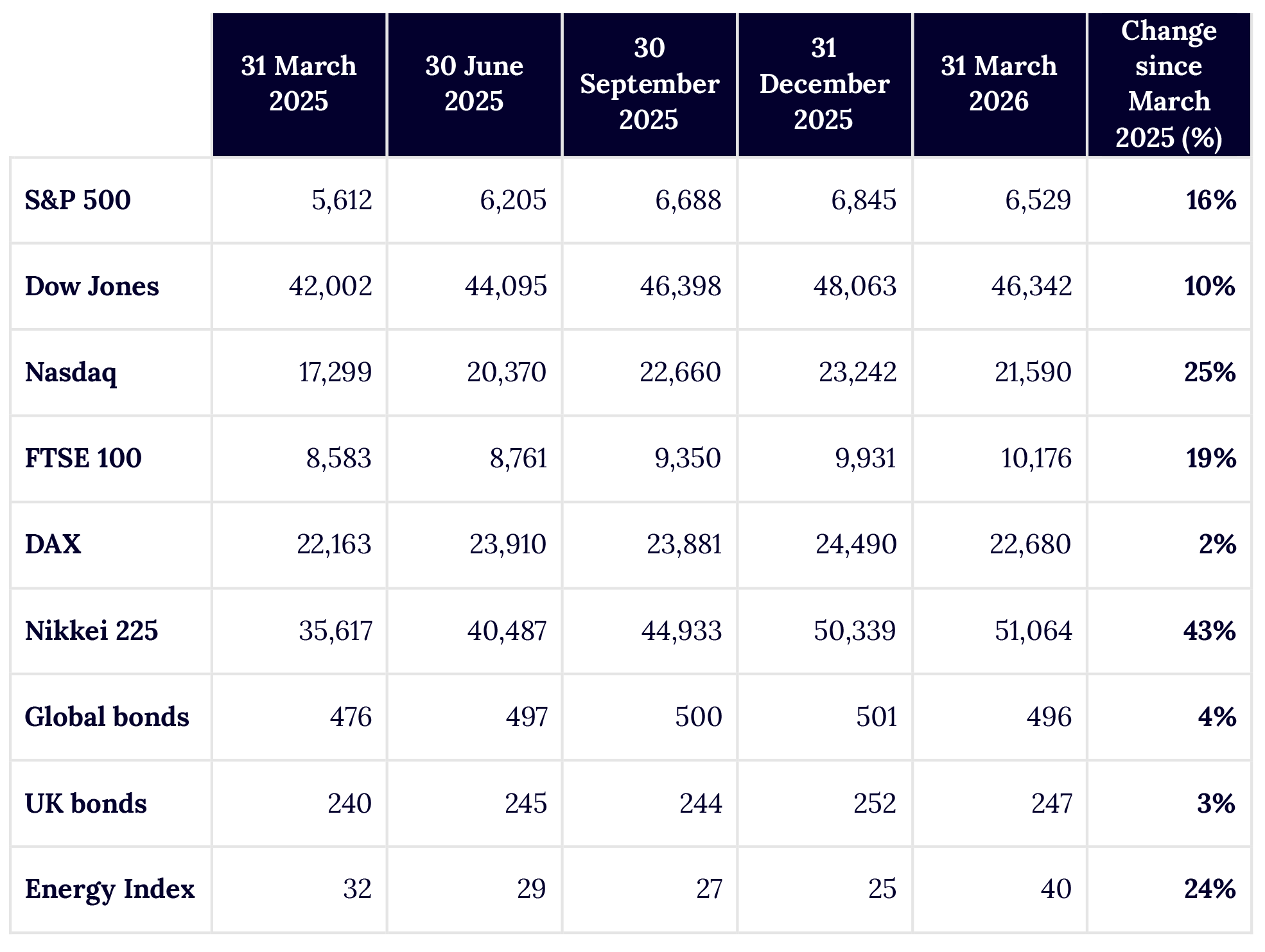
None of the four central banks we cover changed interest rates in the first quarter of 2026.
The Federal Reserve (Fed) is seeking clearer evidence that tariff-related inflation is easing before considering rate cuts. This has been complicated by higher energy prices. Central banks can typically look through oil-driven inflation if it does not feed into expectations, but this remains uncertain. Chair Powell has indicated the Fed is well placed to wait and assess developments, although inflation has been above target for an extended period, limiting flexibility. While the broader bias remains towards easing, the bar for any rate increase is high unless more persistent inflation emerges.
President Trump has nominated Kevin Warsh to succeed Jerome Powell. While viewed as a conventional choice, Warsh has suggested that AI-driven productivity could support lower interest rates. If inflation proves more persistent, this could raise concerns about the Fed falling behind the curve. His appointment remains subject to Senate approval, and if delayed, Powell is expected to continue in an interim capacity.
The European Central Bank (ECB) has been on hold since last June. However, with inflation rising from 1.9% in February to 2.5% in March, there is increasing debate around whether rates may need to rise. Markets are now pricing in two to three modest increases by year-end.
Governing Council member Isabel Schnabel has indicated that the ECB can afford to assess developments carefully, but has also made clear that it would act if inflation shows signs of becoming more persistent.
The Bank of England (BoE) had been expected to cut interest rates again this spring in response to improving inflation data, but has moved to an “on hold” stance while it assesses the impact of the energy price increases. The divisions that have marked recent decisions (there was a 5 to 4 vote in favour both of cutting rates in December and holding in February) could re-emerge, with some members favouring rate hikes and others calling for staying on hold or even cutting rates. However, as in the US, the bar to a rate hike looks high, though one is certainly possible if the BoE becomes concerned about inflation persistence.
The Bank of Japan (BoJ) has kept rates unchanged so far this year. However, it is expected to continue its policy normalisation: Governor Ueda has stated that underlying inflation is showing signs of reaching a sustainable level of 2% after being too low for many years. The BoJ is expected to carry out a further 25bp hike in its policy rate to 1.0% at one of its next few meetings, possibly as early as April.
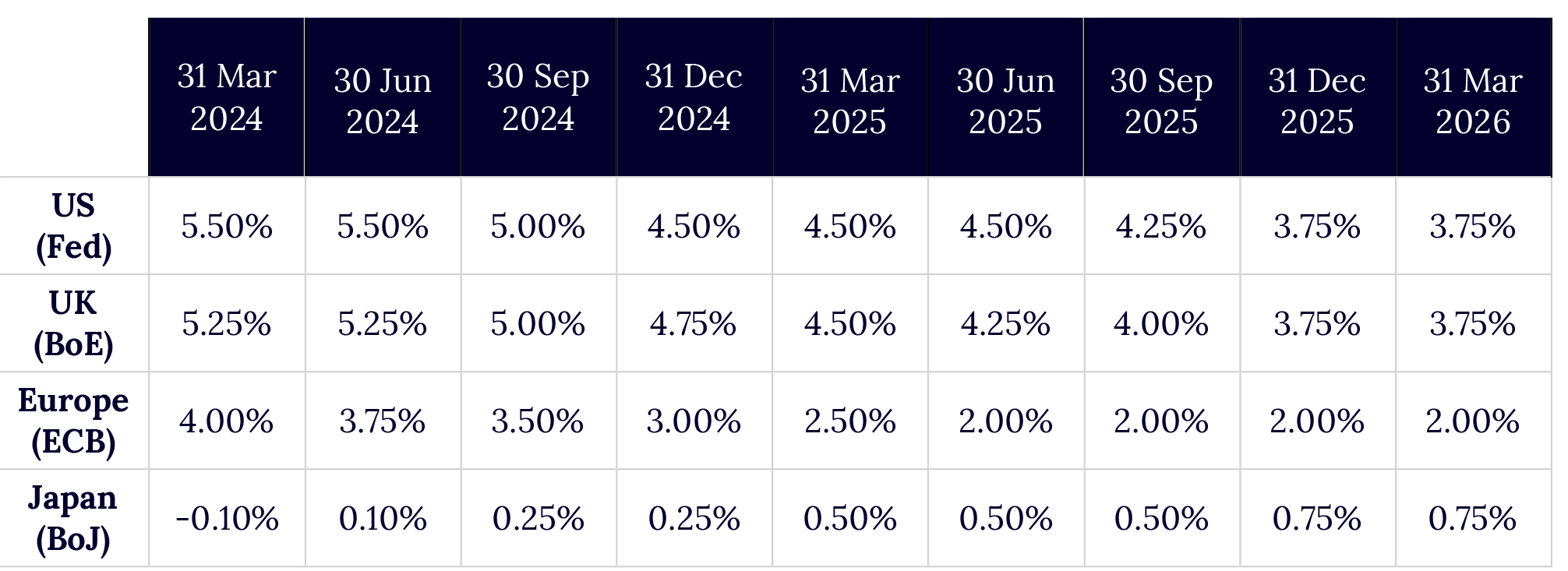
Recent trend: slightly down (stronger dollar)
Outlook: ambiguous
Euro/dollar edged down in the first quarter, making an attempt to break out of the 1.15-1.18 range it has mostly fluctuated in since last summer. It touched around 1.14 at the low, but then rebounded again. The dollar was boosted first by the nomination of Kevin Warsh as the new Fed chairman. It then strengthened again modestly after the outbreak of the Iran war, in keeping with the traditional “safe haven” pattern, but by less than in previous crises. Looking ahead, the outlook is ambiguous. While the war is likely to hit the European economy more than the US, the ECB looks more likely to raise rates than the Fed, indeed the Fed may cut rates. Pressure on the Fed to cut rates (or not hike) from the president could weaken the dollar if the inflation passthrough from the higher oil price is worse than expected.
Recent trend: slightly down (stronger dollar)
Outlook: ambiguous
After a burst of sterling strength in January/February that took sterling/dollar up to 1.38, it fell back again over the remainder of the quarter and ultimately moved in line with EUR/USD, with the dollar strengthening modestly against sterling.
The OECD is forecasting that the UK economy will suffer the biggest hit among developed economies from the energy price shock. This is sterling-negative. Also, the Bank of England is not expected to hike rates in response to higher inflation (though a hike cannot be ruled out). Sterling would benefit if sentiment turned against the dollar, for example, if the market believed Fed policy was excessively loose.
Recent trend: neutral
Outlook: neutral to up (stronger euro)
The euro/sterling currency pair moved sideways in the first quarter within a narrow range. A rate hike is now seen as likely in the eurozone over the next six months, which would be positive for the euro. Even if the BoE may be slower to cut rates, a rate hike is not currently expected.
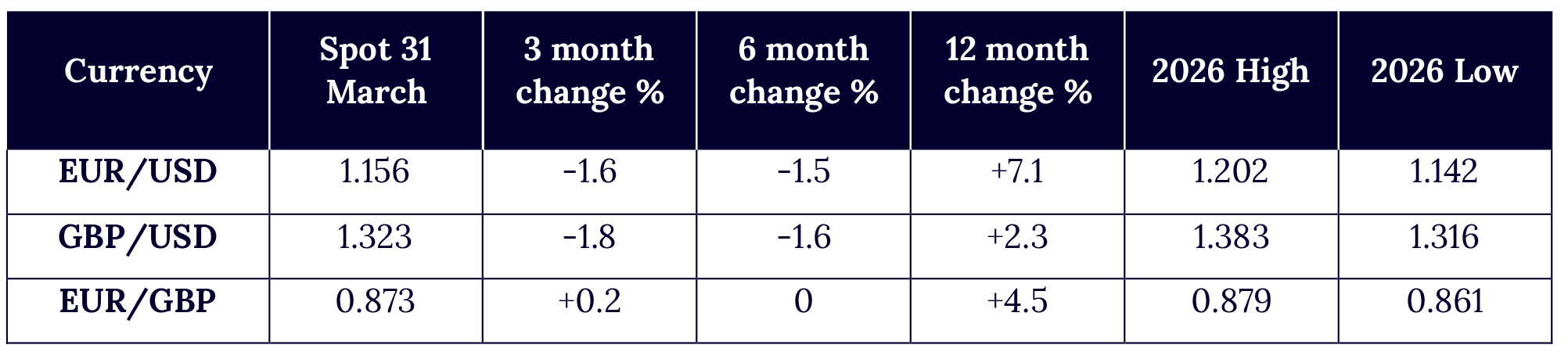
This quarter, we have moved from a “neutral” to a “cautious” outlook on the financial markets, as we believe the downside risks have increased. Of course, there is still upside potential in riskier asset classes such as equities and there are still possible positive scenarios for the future (particularly in the medium term), even though we believe these are less likely at present. As before, we recommend holding a moderate allocation in all mainstream asset classes. A moderate, diversified allocation would have weathered the market downturn since February reasonably well.
Gold’s bull run was finally interrupted in the first quarter as it reached a record high of $5,300 before retreating. It was still up 8% in the first quarter as a whole, however, and 60% over the past year. It is hard to see gold exceeding this peak, so for now upside may be limited. Gold has become riskier and more volatile over the past year or two but still has a role to play as a hedge in portfolios.
As we noted last quarter, bonds are in some ways the linchpin asset class in 2026. Predictably, bonds were hit in the initial energy price spike, as inflation fears took hold and the market switched from anticipating rate cuts to building in forecasts of rate hikes. But if the inflation spike leads to an economic slowdown, bonds could eventually rally. If bonds continue to struggle, we could face a 2022 scenario where all asset classes except cash perform badly.
In practice, this reinforces the importance of maintaining alignment between portfolio structure and long-term objectives, rather than reacting to short-term developments.
The outlook remains uncertain, particularly in relation to inflation and the potential impact of higher energy prices on growth. While the direction is not yet clear, this reinforces the need for a measured and disciplined approach.
In this environment, well-structured and diversified portfolios should be designed to absorb periods of volatility without requiring reactive change. Our focus remains on ensuring each portfolio continues to reflect long-term objectives, risk tolerance and liquidity needs, supported by ongoing dialogue and careful review.