Markets have shrugged off a lot. Could inflation finally crack them?
Download PDF VersionCurrently, the biggest obstacle facing the markets is inflation. A lot is riding on whether the Middle East conflict escalates further or de-escalates, and on how far rising energy costs spill over to other prices.
There are optimistic and pessimistic scenarios for each of these, but bad news on inflation would lead central banks to further tighten monetary policy, push bond yields up further and could potentially trigger an equity market correction. A further risk is the ever-present geopolitical risks, which could erupt in several hotspots at any time.
Our market perspective this quarter is cautious. The market perspective shows where we see the balance of risks at present (but is not intended to be a short-term market forecast). A cautious perspective means we believe the downside risks currently outweigh the upside. For a further discussion of upside and downside risks, see Reasons to be optimistic and Reasons to be cautious sections of the report.
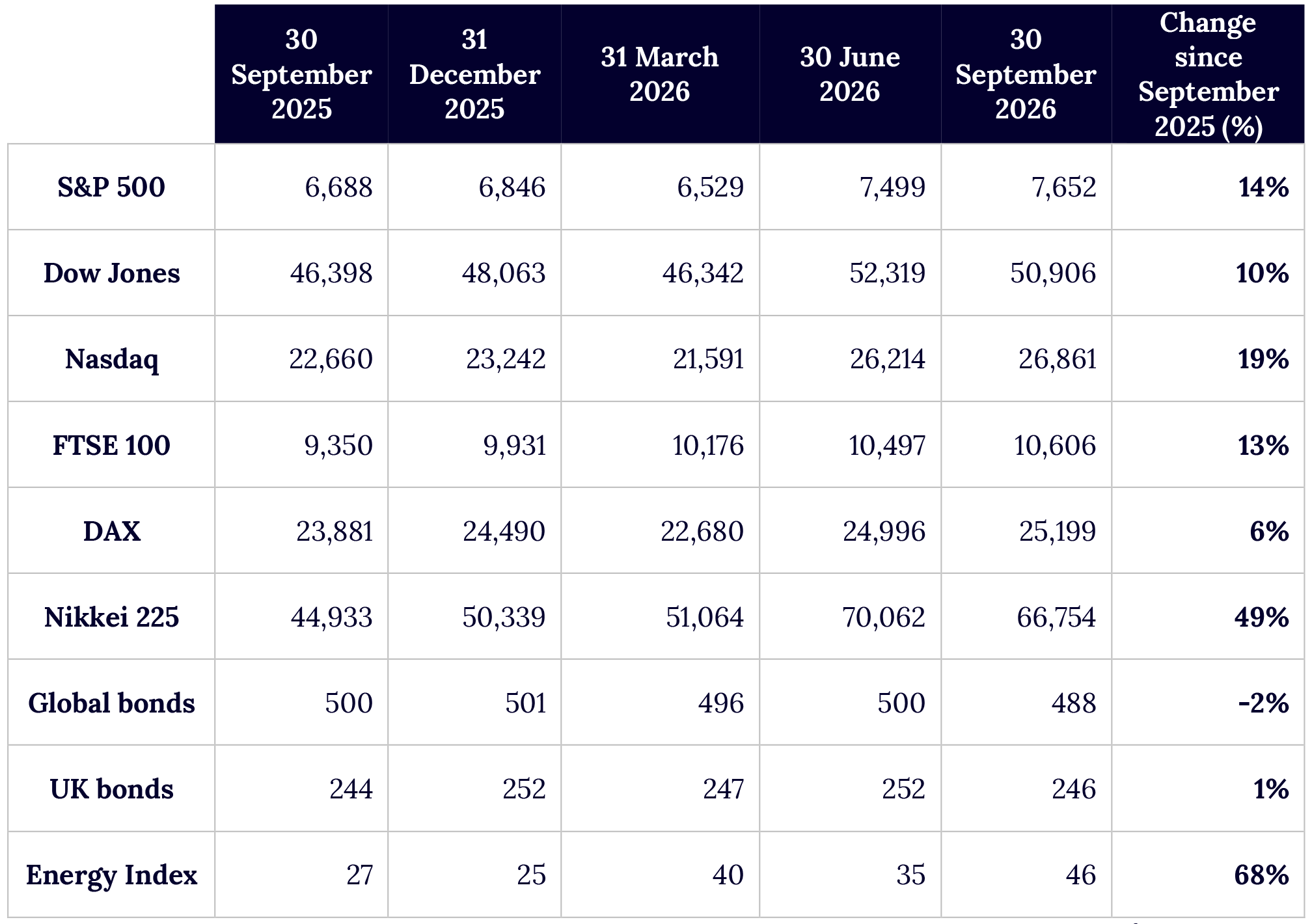
Hopes of an end to the Iran conflict in June proved premature. The fall in the oil price was short-lived and prices rose back to over $100 per barrel. Higher energy prices fed through to headline inflation and the US Federal Reserve (the Fed) and others raised interest rates to head off inflationary pressure. Bond yields soared and dominated the market narrative. Stock markets were not left unscathed, with the major indices roughly flat in the third quarter.
Of course, there are still important positives. One that is perhaps still underestimated is the resilience of the global economy. It is growing in sync with no major region in recession, which in itself is unusual. Unlike in previous cycles, consumer balance sheets are relatively strong and unemployment is low. Growth may not be very fast, but moderate growth is a good environment, perhaps even the optimum one, for corporate profits. Earnings growth at listed companies remains very strong in most stock markets.
The AI theme has remained dominant in the US in particular, even if the market has discriminated carefully between winners and losers, as the divergent performance of the “Magnificent 7” stocks over the past year demonstrates. There continue to be important growth opportunities in technology, even if a downturn in the AI narrative is possible. We return to the issue of whether AI is a bubble in the Tech & AI section.
Anthropic is expected to launch its IPO in the fourth quarter. This will give the market access to a pure play AI lab building the most advanced frontier models for the first time and provide much more public information on model adoption, customers and pricing and the business model generally. The market valuation is expected to be around $2 trillion, which would make it around the sixth-biggest company in the US. Anthropic’s close rival OpenAI has reportedly delayed its IPO until 2027. The IPO will likely attract very high demand and further increase market concentration in the AI theme.
Macroeconomically, the focus will be on inflation in the major economies and its consequences for monetary policy. Firstly, will energy prices continue to put upward pressure on headline inflation and secondly, will this supply shock lead to second-round effects that spill over into the rest of the economy? The Fed will want to see at least stable core inflation to hold off on another rate hike, and the European Central Bank (ECB) and Bank of England (BoE) also have their fingers on the trigger.
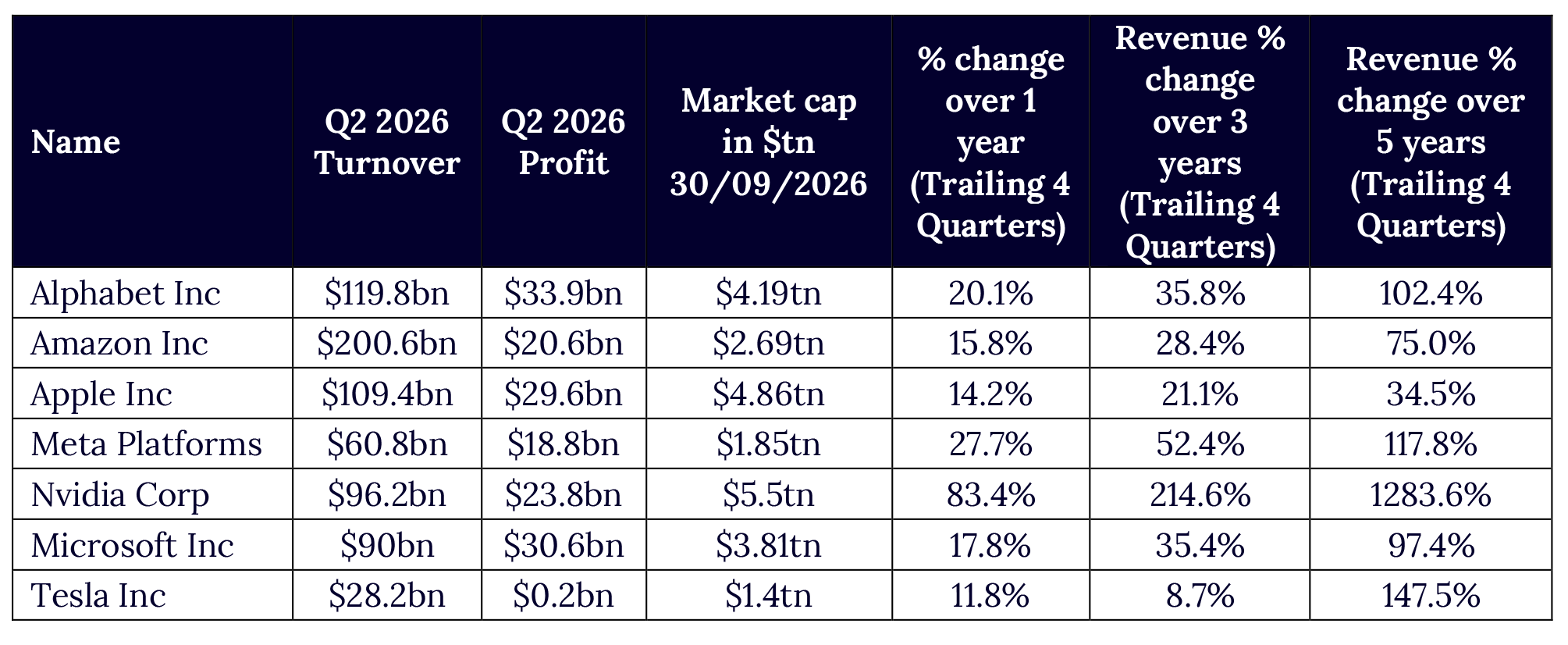
It was a stronger quarter for the Magnificent 7 technology stocks. After lagging the Nasdaq index in the first half of 2026 (leading them to be rechristened “Lag 7” by some), all except Alphabet and Tesla were ahead of the index in the third quarter. There was a reshuffle of the performance hierarchy. Alphabet, which has been the best performer in recent quarters, was down slightly. The other hyperscalers (Amazon, Meta and Microsoft), had a better quarter, suggesting that the market has become more comfortable with their spending on AI infrastructure, probably because the market is starting to see that this investment is generating revenues. Meta and Microsoft recovered from a torrid first half with jumps of 29% and 37% respectively in their share prices. So far this year Apple and Nvidia are the best-performing stocks among the 7 tech giants, up 22%. This is interesting, as these two stocks are the most and least exposed to AI. Unlike the other constituents of the Mag 7, Apple has not spent heavily on AI infrastructure or models and remains a purveyor of consumer hardware. Meanwhile semiconductor stocks, which went on a tear in the first half before a correction in June and July, were fairly steady in the third quarter.
Is AI a bubble? Further thoughts
Because of its importance for investors, we return to this question again this quarter. There are at least two angles we can approach it from: firstly, is AI an investment bubble, and secondly, is AI a bubble in terms of inflated claims or expectations about what it will actually do and how widely it will be adopted? The two are interlinked to some degree, but it may be useful to think about them separately first of all.
Economy strengthening
US GDP growth remained solid in the second quarter at 2.2% and forecasts for the third quarter are for an acceleration in the growth rate.
Job growth has recovered from around zero in 2025 to an average of 80,000 per month in 2026. Retail sales are growing robustly, helped by the tax rebates in Donald Trump’s signature One Big Beautiful Bill Act, and were up 6% year-on-year in August. The manufacturing sector has also firmed, with the ISM purchasing managers’ index remaining above the no change level of 50 throughout 2026, and standing at 54.6 in August. However, solid economic growth has not been reflected in consumer confidence, which has weakened in 2026, primarily due to concerns about inflation.
Higher oil prices pushed Consumer Price Index (CPI) inflation up to 3.4% in August. However, the spillover to other sectors has, so far, been limited, while the impact of tariffs appears to be fading. Core CPI inflation has actually fallen from a peak of 2.9% in May to 2.4% in August. However, the Federal Reserve’s preferred inflation measure, core PCE inflation, was 3.0% in August, still well above the Fed’s 2% target.
Signs of a pickup in Germany
Higher energy prices pushed headline inflation up to 3.2% in August. As in the US, so far the knock-on effect to other sectors is limited and core inflation (excluding food and energy prices) was virtually unchanged at 2.4%, only marginally higher than 2.3% in August 2025. The closely watched rate of services inflation, often seen as an indicator of underlying inflation pressures, eased to 3%, its joint-lowest level this year.
GDP growth was a relatively robust 0.6% quarter-on-quarter between April and June following a flat first quarter and grew 1.2% year-on-year. Data for the manufacturing sector has strengthened in recent months, led by Germany. The eurozone manufacturing PMI has risen steadily this year to 52.7 in August, comfortably above the no growth threshold of 50, while the German PMI recorded its strongest month of growth since 2022. The upturn in the German industrial sector is confirmed by the closely watched ifo Business Confidence Index, which has recovered from a dip at the start of the Iran war and reached its highest level since 2023 in September.
Consumer data has been less strong but is consistent with slow but positive growth. Retail sales were up 0.6% year-on-year in July in real terms in the euro area, while the unemployment rate has been steady at between 6.2% and 6.4% since 2024.
No longer an inflation outlier
In line with other Western countries, GDP growth was a little stronger in the first half of the year at 0.6% in the first quarter and 0.4% in the second, or an annualised rate of 2.1% in the first half of 2026. The manufacturing sector has also participated in the upturn seen globally this year. The S&P manufacturing PMI has been above 50 since the end of last year, although it has slipped back from a high of 53.9 in May to 51.7 in August.
The labour market is flat. Unemployment was 4.9% in the 3 months to July 2026, up slightly from 4.7% in the same period in 2025, while employment fell 0.3%. The consumer side of the economy has strengthened modestly. Retail sales were up 2.4% year-on-year in August in real terms and consumer confidence rose to its highest since the summer of 2024, possibly reflecting a “honeymoon” period for the new prime minister Andy Burnham.
Compared with other countries, the UK is no longer an outlier with stubbornly high inflation. The rise in oil prices has so far had a smaller impact than feared: headline CPI inflation stood at 3.1% in August (below the US and euro area), while core CPI has been steady at 2.6% for four months. A year ago core CPI was a full percentage point higher at 3.6%. The improvement is underlined by the continuing fall in services inflation to 3.4% in August, down from 4.7% a year ago. Wage growth has also slowed from over 5% a year ago to 3.5% in May to July 2026. This improving trend has allowed the Bank of England to remain on hold.
China continues to have a two-tier economy, improving data from Japan
The Chinese economy remains divided between a strong export sector and weak domestic demand, hobbled by the chronic malaise in the property market that has dragged on for five years. GDP growth was 4.3% in the second quarter, at the bottom end of the new lower 4.5% to 5% official growth target. Exports were up 25% year-on-year in dollar terms in August, while industrial production rose 5.2%, reflecting the strength in exports and the country’s investment in technology and AI. Domestic indicators were sluggish, however: retail sales were up just 0.4% year-on-year in August and fixed investment in the domestic economy fell 7.2% in the first eight months of the year (with investment in real estate down almost 20%). The authorities announced further measures to revitalise the property market at the end of August. So far, the interventions have not had the desired effect, however, as property sales and prices continue to fall. The State Council announced that it will take further steps to stimulate domestic demand at the end of September, but it remains to be seen if these are decisive enough to have a significant impact.
China’s surging exports are causing concern in Europe in particular, where there are fears that they could hollow out European industry, most notably the automotive sector. The EU is currently considering restrictions on Chinese imports to reduce its growing trade deficit with China. Meanwhile at the summit between Presidents Xi and Trump the two countries agreed to extend their trade truce by only 2 months to January 2027 and established a hotline to notify each other about AI safety incidents.
The Japanese economy continues to grow at a moderate pace, with GDP growing 1.4% annualised in the second quarter, following 1.8% growth in the first quarter. The September Tankan business confidence index rose to +24 from +22 in June, reaching its highest level since March 2018. Prime Minister Sanae’s fiscal stimulus should continue to support growth in the remainder of this year and into 2027. Core inflation excluding food and energy was 1.9% in August, not a high level compared to the US and Europe, but confirmation that the Japanese economy has escaped from deflation and is close to reaching a sustainable level of 2% inflation.
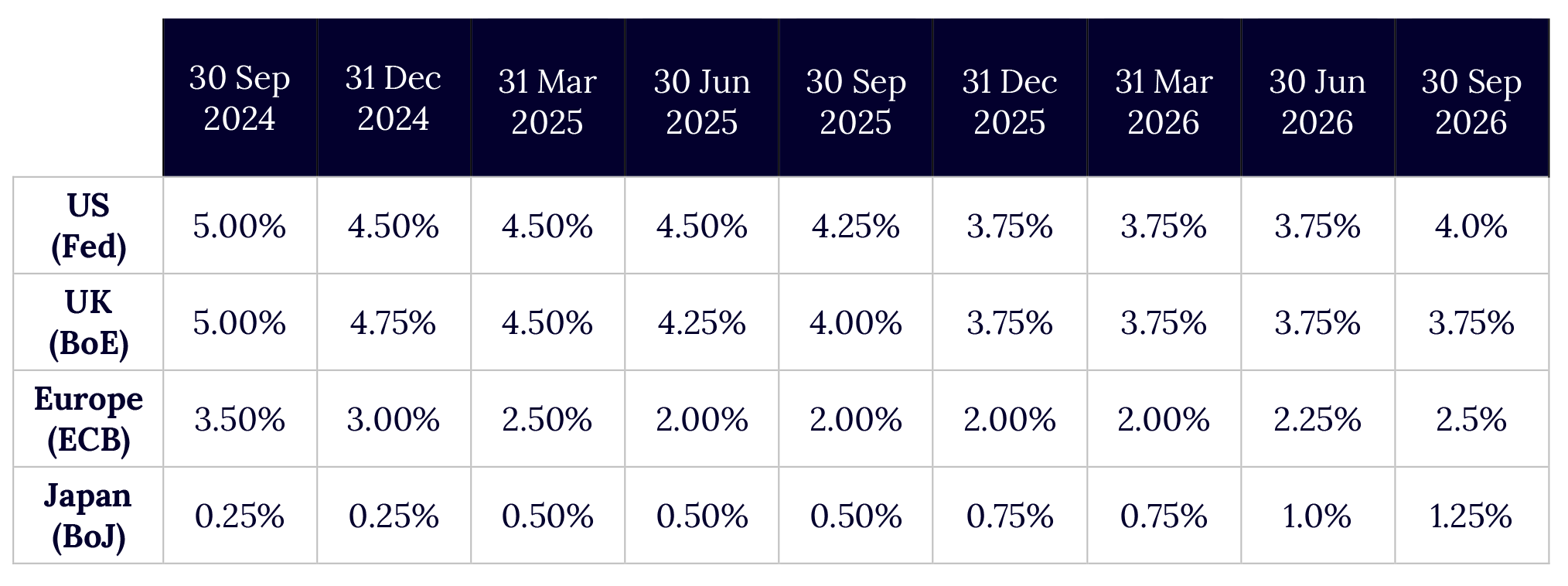
The US Federal Reserve (Fed) raised interest rates by 25bp to a target range of 3.75% to 4.0% at the September Federal Open Market Committee (FOMC) meeting. This was as much a response to the persistent overshoot in inflation as to any recent deterioration. Indeed, the effect of tariffs and rising oil prices has been weaker than expected so far. Chairman Kevin Warsh pointed to evidence that the economy has strengthened in recent months and argued that this indicates that policy is not restrictive. He described the hike as “removing a dose of accommodation”. The majority of the “dot plot” forecasts of FOMC members (except Warsh, who does not participate) are for one to at most two further hikes over the next year, but the market is pricing in three more 25bp rate hikes.
September’s rate hike reduced some of the uncertainty surrounding Warsh’s policies. Before becoming Fed chair he spoke about the possible disinflationary impact of AI, which appeared to chime with President Trump’s well-known preference for much lower interest rates. So there have been concerns he would be reluctant to incur the president’s wrath by raising interest rates if the inflation outlook warranted it. On top of this, Warsh’s opposition to forward guidance further raised uncertainty about what the Fed would do. This hike showed that he is willing to raise rates if necessary, though it remains to be seen if he can stomach a series of hikes if it looks necessary to return inflation to 2%, which he has said he is determined to achieve.
The European Central Bank (ECB) raised interest rates from 2.25% to 2.5% in September, in response to the pickup in euro area inflation in recent months. ECB President Lagarde has stated that the central bank will take a data-dependent and meeting-by-meeting approach to policy from here. Further rate hikes are possible but not certain.
The Bank of England (BoE) has been on hold this year while it assesses the impact of the energy price shock deriving from the Iran war. At the September Monetary Policy Committee meeting, the committee noted there has been little evidence so far of second-round effects, but described the inflation risks as tilted to the upside, which suggests that some easing in energy prices will be needed to prevent the Monetary Policy Committee (MPC) from raising rates at its next meeting in November. However, a large upward move in short-term interest rates over the next year looks unlikely.
The Bank of Japan (BoJ) raised interest rates to 1.25% in September, its third hike this year, continuing its policy normalisation from negative rates that prevailed until 2024. The BoJ has become more confident that underlying inflation is converging on a sustainable rate of 2% and the economy no longer needs exceptional monetary stimulus. The international dimension of the move was just as important. The US and Japan intervened jointly to support the yen in July and August when it fell to 40-year lows below 160 to the dollar. US Treasury Secretary Scott Bessent is believed to have put pressure on the Japanese authorities to speed up their monetary tightening in order to strengthen the yen. One of the reasons for the BoJ’s caution has been the opposition of the Takaichi government – which has a strongly reflationary agenda – to rapid rate hikes. A further hike is expected later this year or in early 2027.
The following themes are intended as food for thought and do not represent a formal currency forecast.
Recent trend: down (stronger dollar)
Outlook: down
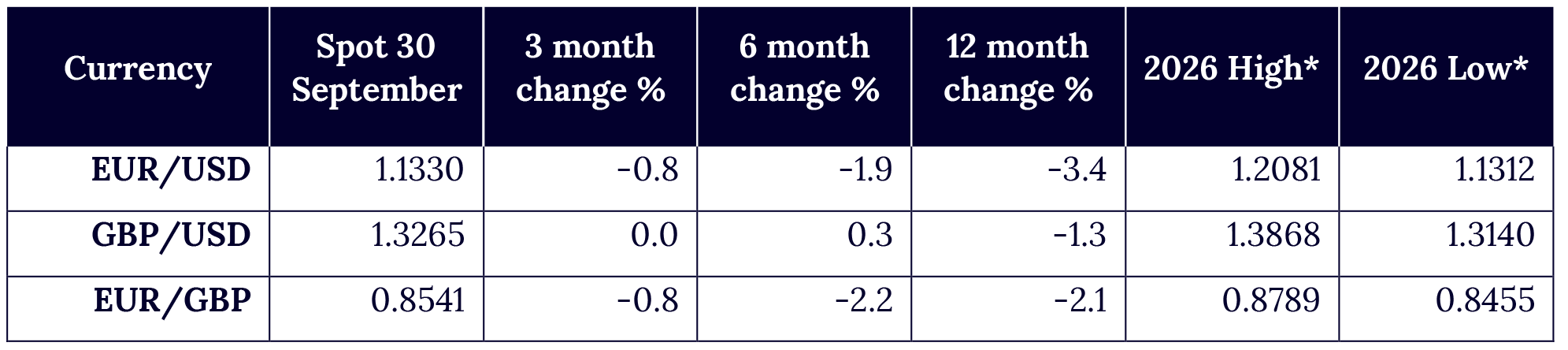
The dollar strengthened in September in the aftermath of the Fed rate hike, reaching its high for the year. The dollar has now recovered around a third of its losses in 2025. The rate hike boosted confidence in the Fed and US policymaking more generally. High energy prices will have a more adverse impact on the European economy than the US and suggest the US will maintain a clear lead in economic growth. Capital inflows into US stocks also remain very strong. A resolution of the Middle East conflict that led energy prices to fall back to pre-war levels – a distant prospect at present – could boost the euro.
Recent trend: neutral
Outlook: neutral
Sterling rose in July and August, reaching highs of over 1.36. In line with other pairs, it weakened again in September as the dollar rose across the board and ended the quarter virtually unchanged. After the Fed rate hike, there is now a small rate differential in favour of the dollar, but this is not expected to widen over the coming months, and indeed may close if the Bank of England raises rates later this year. For now the US is growing more rapidly than the UK, but signs that the UK is getting to grips with its fiscal problems and lifting its growth and productivity performance – or signs of slower growth or inflation in the US – could boost sterling.
Recent trend: down (stronger sterling)
Outlook: down
The euro/sterling currency pair edged down in the third quarter, continuing its gradual decline this year. The euro benefited from the ECB raising interest rates, which enabled the euro to recover from its lows, but was not sufficient to break out of its downtrend. The two economies are growing at roughly the same rate (slightly faster in the UK) and the inflation performance has also largely converged. The two economies are roughly equally exposed to energy prices – both positively and negatively. An improvement in economic performance leading to stronger growth and lower inflation is perhaps marginally more likely in the UK, and would boost sterling. If the Bank of England carries out fewer than the three rate hikes currently anticipated by the markets, sterling could weaken.
We have described our current market perspective as “cautious”. This means we believe the downside risks on the markets currently outweigh the upside risks. Nevertheless, there are potential sources of upside across several asset classes. Equity markets still offer important growth opportunities, while less risky assets, such as bonds and cash, may provide resilience in recognition of the background risks.
Bonds are the linchpin asset class to watch at the moment. Fears of rising inflation due to the oil price spike becoming entrenched have been reflected in rising bond yields, with high levels of government debt and possibly bond issuance by hyperscalers a contributing factor. A further rise in yields could drag down the stock markets. However, although it looks some way off at the time of writing, it is also worth considering a more positive scenario. Even if oil prices remain high, the one-off impact will begin to fade next year and, to date, the passthrough to other prices has been muted. If inflation eases in the US and elsewhere faster than expected, bonds could rally for the first time in many years, which would be positive for all financial assets.
In equities, AI remains the dominant theme. There will likely be some big winners in AI (some of whom may be the current tech giants), providing continued potential upside for technology stocks. With broad US and global indices increasingly concentrated in technology, other geographies, industries and small/medium caps may provide additional sources of upside and diversification. However, diversification within equities only offers limited protection in a market downturn.
Gold also continues to have potential supportive factors. It rose in the third quarter, benefiting from the “debasement” trade (the argument that governments will be forced to debase their currencies to manage their huge debts). Gold will probably perform best if inflation continues to rise, but even if inflation is lower than expected it could gain some support from lower US interest rate expectations, potentially limiting the downside.
Cash may also provide diversification benefits in the current environment, especially given the volatility of bonds and gold.
The world looks a little less comfortable than it did three months ago. The global economy has remained remarkably resilient and corporate earnings are strong, but higher energy prices, renewed inflation concerns and rising bond yields have changed the balance of risks. That is why our perspective has moved to cautious.
Cautious does not mean pessimistic, nor does it mean that we expect markets to fall. Much depends on what happens to inflation from here. If the effect of higher oil prices remains relatively contained, pressure on central banks and bond markets should eventually ease. If higher costs spread more widely through the economy, further rate rises and higher bond yields could put increasing pressure on markets.
For our families, the market is not the starting point. You are. We already know your circumstances, what you are trying to achieve and what is changing in your world. Our job is to decide whether what is happening in markets actually matters to you. Often it does not.
That is why the question we ask is not simply “What will markets do next?” but “Does anything that has changed affect what this family is trying to achieve?” Sometimes the answer will be yes. Often it will be no. Knowing the difference matters.
Our role is to understand the whole picture, challenge assumptions where necessary, and make sure that investment decisions remain connected to everything else. Markets will change, headlines will change, and occasionally the rocks in the road will get bigger. But unless the destination has changed, there is rarely a good reason to change direction simply because the road has become more difficult…
CEO