Thought Leadership

The rock in the road- Highlights

Markets have shrugged off a lot. Could inflation finally crack them?

Download PDF Version

Currently, the biggest obstacle facing the markets is inflation. A lot is riding on whether the Middle East conflict escalates further or de-escalates, and on how far rising energy costs spill over to other prices.

There are optimistic and pessimistic scenarios for each of these, but bad news on inflation would lead central banks to further tighten monetary policy, push bond yields up further and could potentially trigger an equity market correction. A further risk is the ever-present geopolitical risks, which could erupt in several hotspots at any time.

Our market perspective this quarter is cautious. The market perspective shows where we see the balance of risks at present (but is not intended to be a short-term market forecast). A cautious perspective means we believe the downside risks currently outweigh the upside. For a further discussion of upside and downside risks, see Reasons to be optimistic and Reasons to be cautious sections of the report.

Hopes of an end to the Iran conflict in June proved premature. The fall in the oil price was short-lived and prices rose back to over $100 per barrel. Higher energy prices fed through to headline inflation and the US Federal Reserve (the Fed) and others raised interest rates to head off inflationary pressure. Bond yields soared and dominated the market narrative. Stock markets were not left unscathed, with the major indices roughly flat in the third quarter.

Of course, there are still important positives. One that is perhaps still underestimated is the resilience of the global economy. It is growing in sync with no major region in recession, which in itself is unusual. Unlike in previous cycles, consumer balance sheets are relatively strong and unemployment is low. Growth may not be very fast, but moderate growth is a good environment, perhaps even the optimum one, for corporate profits. Earnings growth at listed companies remains very strong in most stock markets.

The AI theme has remained dominant in the US in particular, even if the market has discriminated carefully between winners and losers, as the divergent performance of the “Magnificent 7” stocks over the past year demonstrates. There continue to be important growth opportunities in technology, even if a downturn in the AI narrative is possible. We return to the issue of whether AI is a bubble in the Tech & AI section.
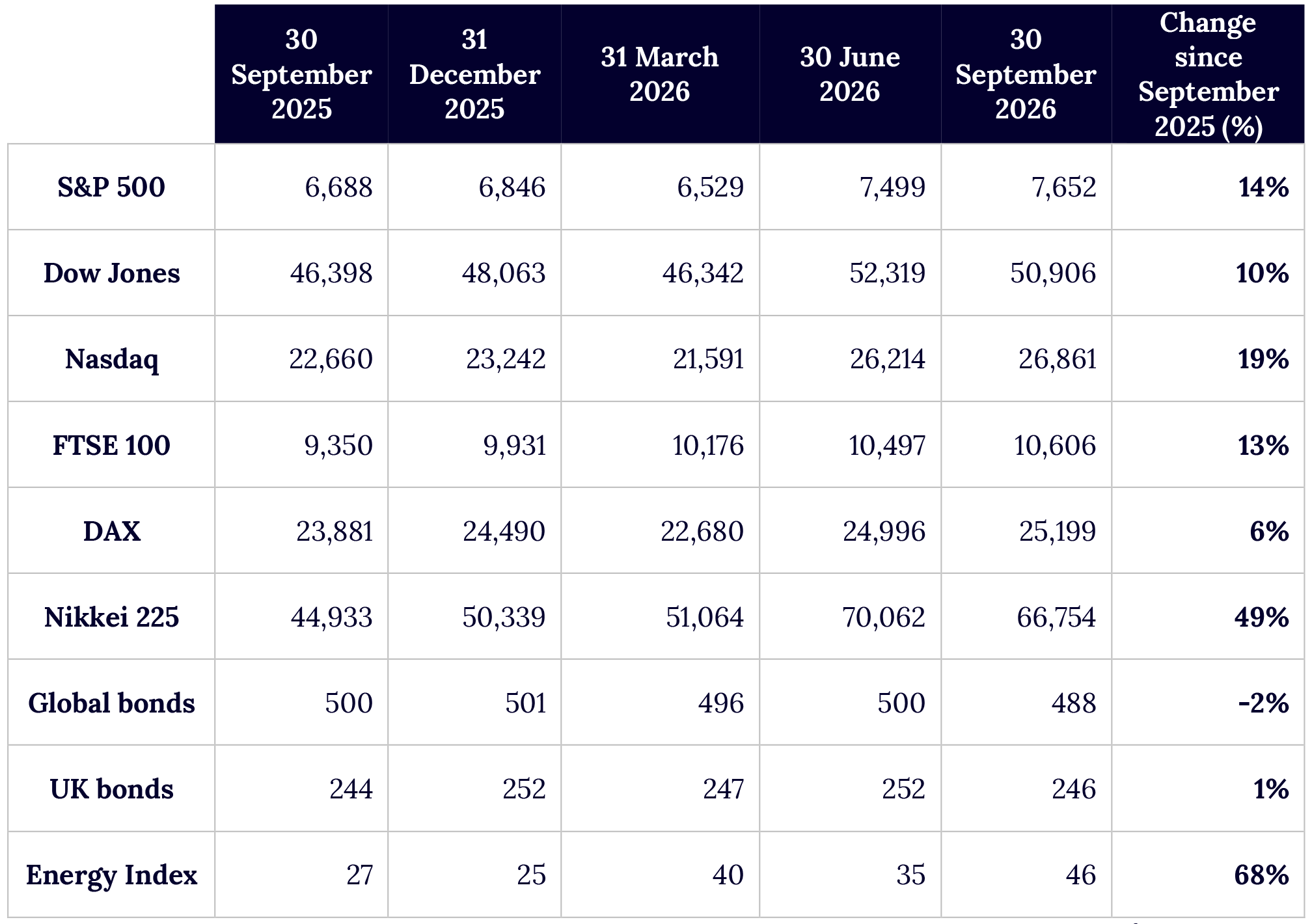
How have the markets performed?

NB: Figures rounded up to the nearest wholenumber.  We have also selected key indices as arepresentation of the markets rather than a substitute for the whole market asthey are the most recognisable for our clients.

Reasons to be optimistic

  • Core inflation well contained…so far: While rising oil prices have pushed up headline inflation in the leading economies, so far the second-round effects have been relatively limited, partly because labour markets are weaker. Central banks may therefore not need to hike interest rates as much as the markets are currently expecting. Headline inflation will in any event come down again next year, even if oil prices remain high. On top of this, a deal to reopen the Strait of Hormuz is possible – perhaps after the US mid-term Congressional elections – and would spark a bond market rally. Further out, an eventual return to rate cuts by central banks is not out of the question.
    ‍
  • Resilient economies and strong earnings growth: It is a familiar refrain, but once again the global economy has demonstrated its resilience this year. Far from being dragged down by the conflicts in the Middle East, growth has actually picked up in many leading economies (indeed, stronger growth is probably one of the reasons behind the rise in bond yields). Growth rates remain moderate, which is typically the optimum backdrop for corporate profitability. Earnings growth of listed companies is exceptionally strong in most industries and countries: S&P 500 earnings, for example, are expected to grow 30% in 2026.
    ‍
  • Growth opportunities in technology and AI: There are huge growth opportunities in agentic and physical AI, robotics and many other areas of technology. Could the technology spark off productivity gains and higher economic growth? While forecasts of 20% economic growth may be hype, the bar for AI to have a positive impact is actually low, since productivity has grown unusually slowly since the financial crisis of 2007-9. By challenging many incumbent businesses, AI will be a disruptive force in the economy. This in itself has the potential to boost growth and productivity, quite apart from any boost to productivity from the technology itself.

Reasons to be cautious

  • Higher inflation, rate hikes and bond yields: The conflict in the Gulf has pushed up headline inflation around the world. With no signs of a resolution at present, central banks may be forced to continue raising interest rates to prevent higher inflation from becoming entrenched. The 10-year US Treasury yield has soared from 4.4% to 5.3% in the space of just three months primarily on concerns about inflation. AI-related bond issuance and stronger economic growth have probably also played a part. While it is impossible to pinpoint any one particular level of bond yields that will “crack” the stock markets (a 5% 10-year US Treasury yield was thought by some to be the critical level, but has not been so far), eventually a continuing rise in bond yields would take us into a 2022-type situation where rising bond yields drag down all financial assets.
    ‍
  • Concentration in AI: Stock markets are concentrated in the AI theme. Nvidia alone accounts for 8% of the S&P, and the combined Magnificent 7, which all have important AI businesses, make up a third of the index. Anthropic and OpenAI’s Initial Public Offerings (IPOs) will exacerbate this concentration. Although there have been occasional flurries in other market sectors, none of them have been able to supplant technology and AI as the primary market driver for any length of time. Therefore, any disappointment in the AI narrative, whether relating to profitability, performance, adoption, government regulation or anything else, could spark a significant equity market downturn. Furthermore, as we pointed out last quarter, there is a further concentration at the macroeconomic level, as AI investment accounts for a significant proportion of economic growth in the US.
    ‍
  • Ongoing geopolitical risks: In terms of its impact on oil supplies, the conflict in the Middle East has already reached an advanced stage of escalation, with both the Hormuz and Bab-el-Mandeb straits partially closed and attacks on Saudi Arabian oil facilities. A further escalation in the form of a return to an all-out war between the US and Iran is possible, but not the most likely scenario at present. Equally, however, no-one looks willing to go down the de-escalation path just yet. The other obvious geopolitical fault line runs through Taiwan in light of the critical importance of TSMC in the manufacture of the fastest AI chips. Any ratcheting up of tensions between China and Taiwan or, for example, an attempted blockade of the island could clearly have severe macroeconomic and market consequences. With geopolitics more unstable than for many decades, other geopolitical flashpoints could emerge at any time.
    ‍

What’s in store for the coming quarter?

Anthropic is expected to launch its IPO in the fourth quarter. This will give the market access to a pure play AI lab building the most advanced frontier models for the first time and provide much more public information on model adoption, customers and pricing and the business model generally. The market valuation is expected to be around $2 trillion, which would make it around the sixth-biggest company in the US. Anthropic’s close rival OpenAI has reportedly delayed its IPO until 2027. The IPO will likely attract very high demand and further increase market concentration in the AI theme.

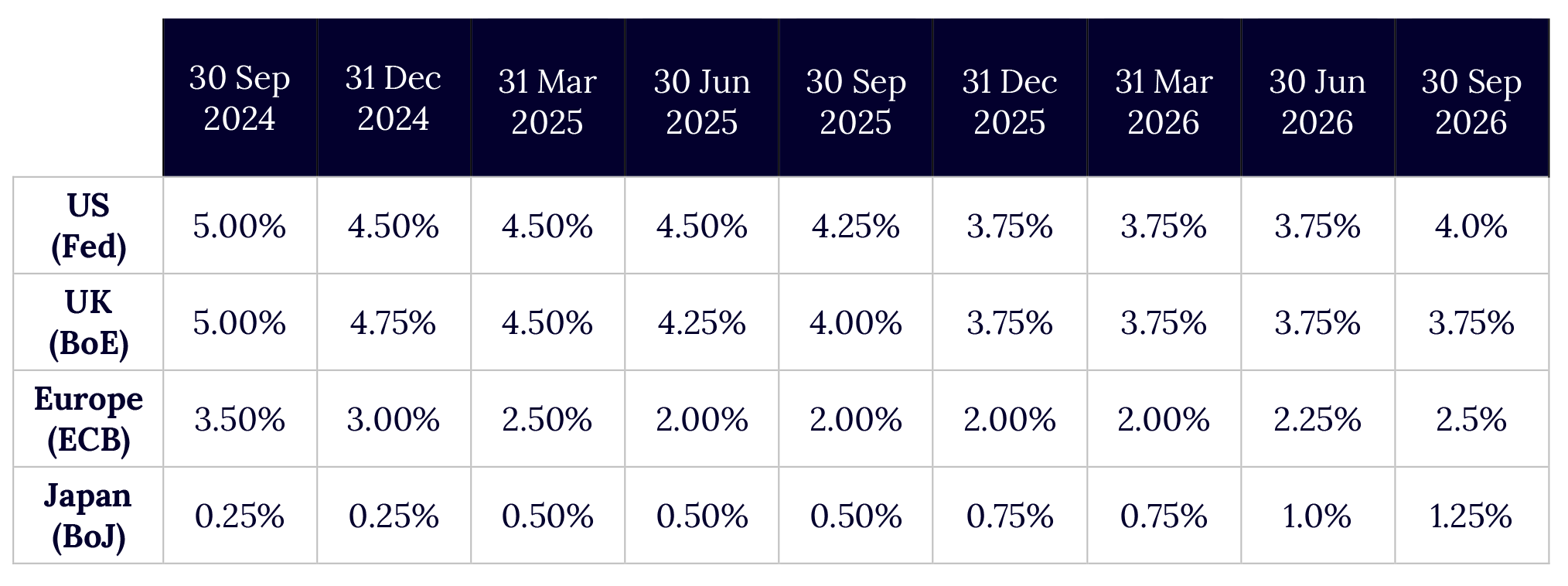
Macroeconomically, the focus will be on inflation in the major economies and its consequences for monetary policy. Firstly, will energy prices continue to put upward pressure on headline inflation and secondly, will this supply shock lead to second-round effects that spill over into the rest of the economy? The Fed will want to see at least stable core inflation to hold off on another rate hike, and the European Central Bank (ECB) and Bank of England (BoE) also have their fingers on the trigger.

Tech & AI

Market review

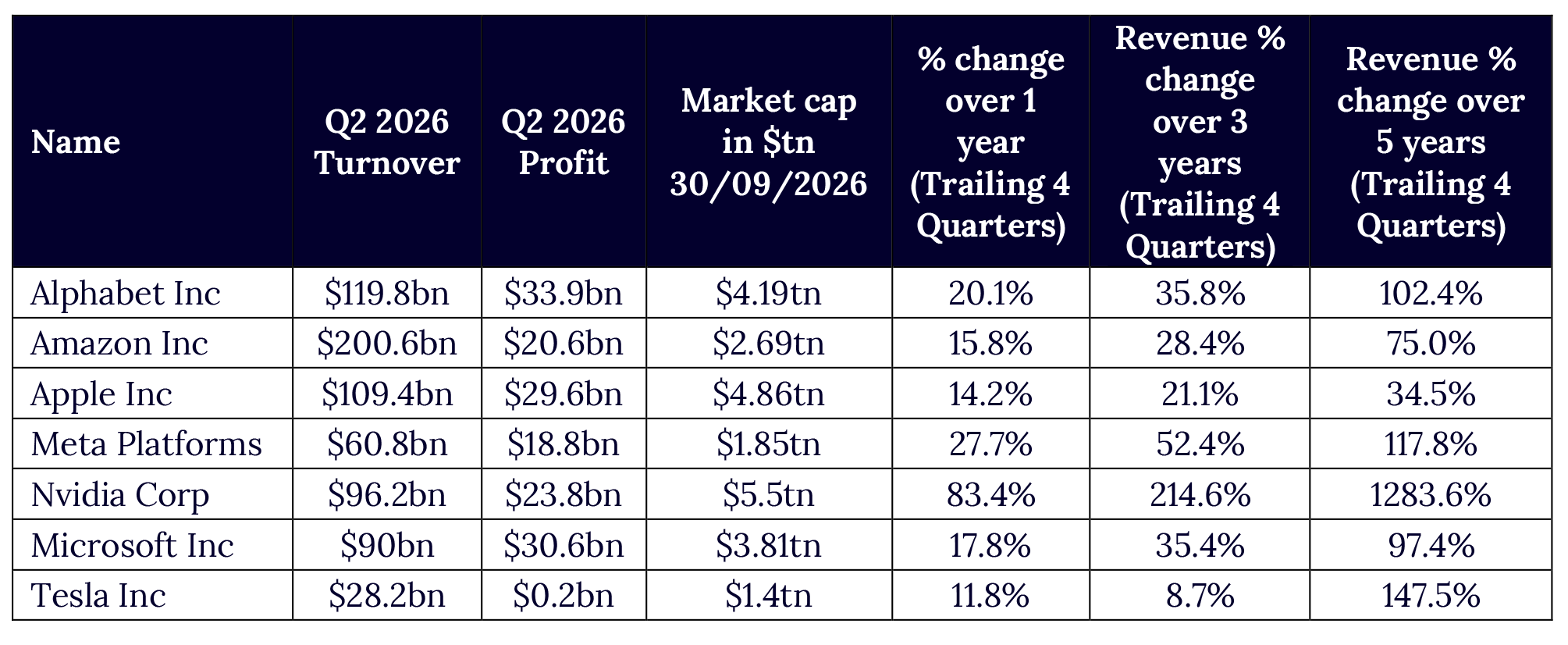
It was a stronger quarter for the Magnificent 7 technology stocks. After lagging the Nasdaq index in the first half of 2026 (leading them to be rechristened “Lag 7” by some), all except Alphabet and Tesla were ahead of the index in the third quarter. There was a reshuffle of the performance hierarchy. Alphabet, which has been the best performer in recent quarters, was down slightly. The other hyperscalers (Amazon, Meta and Microsoft), had a better quarter, suggesting that the market has become more comfortable with their spending on AI infrastructure, probably because the market is starting to see that this investment is generating revenues. Meta and Microsoft recovered from a torrid first half with jumps of 29% and 37% respectively in their share prices. So far this year Apple and Nvidia are the best-performing stocks among the 7 tech giants, up 22%. This is interesting, as these two stocks are the most and least exposed to AI. Unlike the other constituents of the Mag 7, Apple has not spent heavily on AI infrastructure or models and remains a purveyor of consumer hardware. Meanwhile semiconductor stocks, which went on a tear in the first half before a correction in June and July, were fairly steady in the third quarter.

Is AI a bubble? Further thoughts

Because of its importance for investors, we return to this question again this quarter. There are at least two angles we can approach it from: firstly, is AI an investment bubble, and secondly, is AI a bubble in terms of inflated claims or expectations about what it will actually do and how widely it will be adopted? The two are interlinked to some degree, but it may be useful to think about them separately first of all.
  1. Turning to the investment case first, we do not see AI as a stock market bubble, as we have discussed in recent quarters. The reason, at its simplest level, is because the AI boom is being led by the largest companies in the world who can afford the huge investment in AI infrastructure. Unlike many previous financial bubbles – such as the sub-prime mortgage bubble of the early 2000’s – the AI boom is not primarily founded on borrowing and leverage. Most AI investment is being carried out by the Magnificent 7, which are hugely profitable and are financing a substantial portion of this investment from their own free cash flow. Their borrowing and equity raising have increased and is high in absolute terms, but these companies still have low debt levels overall. Even much lower adoption and profitability of AI would not pose an existential threat to them. Moreover, AI use does not necessarily have to live up to the hype for the huge capital investment to pay off, since it will also entrench the tech giants’ dominant market position.

    In terms of listed stocks, the AI universe boils down to two main groups at the moment: the Magnificent 7/hyperscalers and semiconductor and related companies. The hyperscalers are building the infrastructure and the semiconductor companies are benefiting from that spending, which is why their share prices have soared over the past year. The investable universe will broaden when OpenAI and Anthropic, who are currently loss-making, list on the US stock market, and it is only then that investors will begin to have detailed information on the revenues being generated by the use of the models themselves. If there were a downturn in the AI narrative, it would clearly hit the share prices of AI-related stocks, but share price declines of 80% as in the dotcom bust or outright bankruptcies would be very unlikely, except for a small number of fringe players.

    Unlike in the dotcom era, the market has been very discriminating in distinguishing between AI winners and losers. Doubts about the huge capital investments by the hyperscalers and others have led many of these stocks to be punished by the markets at times over the past year. The recovery in some of these stocks this quarter has been due to greater visibility that their capital spending is translating into additional revenues. The valuations of the 7 biggest tech companies are certainly not in bubble territory, as with the exception of Tesla, their PEs are all close to or in some cases below the market average, reflecting their high profitability.

    We have already seen corrections in certain sectors of the market – for example, the pullback in chip stocks after their run-up in the first half of this year and weakness in many of the Magnificent 7 stocks at various times. This makes an across-the-board bursting of a technology bubble based on AI-specific news less likely. A more likely scenario would be a pullback in technology stocks as part of a general stock market correction. We can be fairly certain that there will be a market correction at some point in the future, and we do not need to believe in a tech/AI bubble to anticipate one. Indeed, if there were a market correction, technology stocks might even outperform other sectors, as their businesses might be seen as less cyclical.
  1. Finally, is there a bubble in expectations about the impact of the technology? The answer is we don’t know. However, as we discussed last quarter, we can be fairly sure both that AI is an important technology and that there is hype in some of the claims and expectations surrounding it. We just do not know where and how much. There are clearly huge growth opportunities in AI and the winners will reap huge rewards from it. At the same time, it is certainly possible that there will be disappointments, and that this could spark a downturn in AI or technology stocks at some point. However, rather than speculating on this, a more likely scenario is a market correction for other reasons that pulls AI-related stocks down with it. That will happen sometime in the future irrespective of how the technology pans out.

Q2 results for the Tech Titans and selected highlights

Interest rates

‍

‍

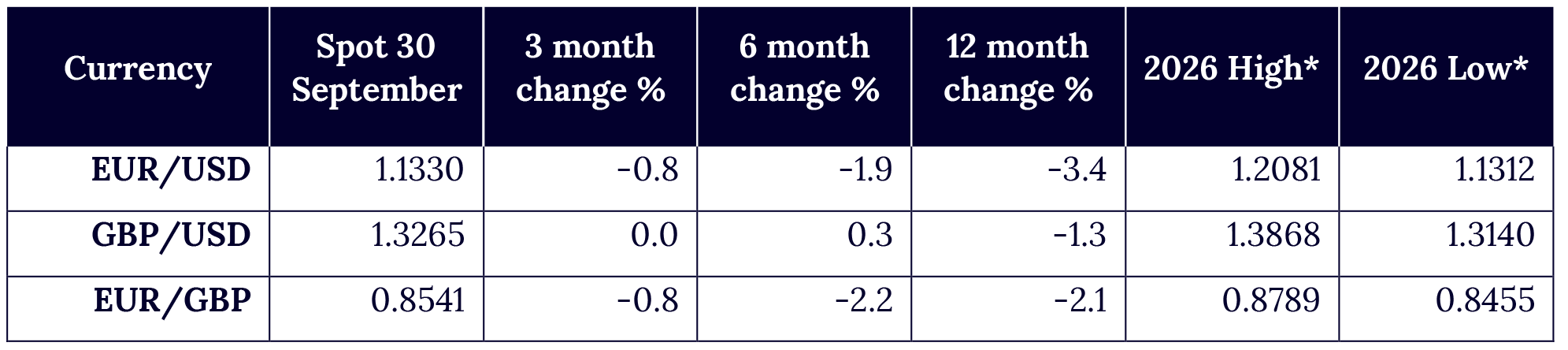
Currency themes and risks

The following themes are intended as food for thought and do not represent a formal currency forecast.

EUR/USD

Recent trend: down (stronger dollar)

Outlook: down

GBP/USD

Recent trend: neutral

Outlook: neutral

EUR/GBP

Recent trend: down (stronger sterling)

Outlook: down
‍

* 1 January to 30 September

Potential upside across asset classes

We have described our current market perspective as “cautious”. This means we believe the downside risks on the markets currently outweigh the upside risks. Nevertheless, there are potential sources of upside across several asset classes. Equity markets still offer important growth opportunities, while less risky assets, such as bonds and cash, may provide resilience in recognition of the background risks.

Bonds are the linchpin asset class to watch at the moment. Fears of rising inflation due to the oil price spike becoming entrenched have been reflected in rising bond yields, with high levels of government debt and possibly bond issuance by hyperscalers a contributing factor. A further rise in yields could drag down the stock markets. However, although it looks some way off at the time of writing, it is also worth considering a more positive scenario. Even if oil prices remain high, the one-off impact will begin to fade next year and, to date, the passthrough to other prices has been muted. If inflation eases in the US and elsewhere faster than expected, bonds could rally for the first time in many years, which would be positive for all financial assets.

In equities, AI remains the dominant theme. There will likely be some big winners in AI (some of whom may be the current tech giants), providing continued potential upside for technology stocks. With broad US and global indices increasingly concentrated in technology, other geographies, industries and small/medium caps may provide additional sources of upside and diversification. However, diversification within equities only offers limited protection in a market downturn.

Gold also continues to have potential supportive factors.  It rose in the third quarter, benefiting from the “debasement” trade (the argument that governments will be forced to debase their currencies to manage their huge debts). Gold will probably perform best if inflation continues to rise, but even if inflation is lower than expected it could gain some support from lower US interest rate expectations, potentially limiting the downside.

Cash may also provide diversification benefits in the current environment, especially given the volatility of bonds and gold.

Conclusion  

The world looks a little less comfortable than it did three months ago. The global economy has remained remarkably resilient and corporate earnings are strong, but higher energy prices, renewed inflation concerns and rising bond yields have changed the balance of risks. That is why our perspective has moved to cautious.

Cautious does not mean pessimistic, nor does it mean that we expect markets to fall. Much depends on what happens to inflation from here. If the effect of higher oil prices remains relatively contained, pressure on central banks and bond markets should eventually ease. If higher costs spread more widely through the economy, further rate rises and higher bond yields could put increasing pressure on markets.

For our families, the market is not the starting point. You are. We already know your circumstances, what you are trying to achieve and what is changing in your world. Our job is to decide whether what is happening in markets actually matters to you. Often it does not.

That is why the question we ask is not simply “What will markets do next?” but “Does anything that has changed affect what this family is trying to achieve?” Sometimes the answer will be yes. Often it will be no. Knowing the difference matters.

Our role is to understand the whole picture, challenge assumptions where necessary, and make sure that investment decisions remain connected to everything else. Markets will change, headlines will change, and occasionally the rocks in the road will get bigger. But unless the destination has changed, there is rarely a good reason to change direction simply because the road has become more difficult…

Mark Estcourt  

CEO

‍

Our doors are open

request a meeting

Thank you! Your submission has been received!
Something went wrong. Please check if you've filled everything correctly